January 16, 2026
By Babette De Naeyer
Just before closing the books for the summer, the European Court of Human Rights (the Court) decided a novel and highly anticipated Article 3 of Protocol No. 1 (Article 3 P-1) case in Bradshaw a.o. v. the United Kingdom (22 July 2025), concerning disinformation and Russian election interference. The case had already sparked scholarly debate while it was still on the Court’s docket.Now, just before the winter break, the Court denied the applicants’ request for referral to the Grand Chamber. Upon closer look, Bradshaw produced no real winners or losers. The UK claimed victory because the Court ultimately found no violation of Article 3 P-1, while the applicants highlighted the Court’s extension of States’ positive obligations under that provision. They nevertheless sought Grand Chamber referral to refine aspects of the reasoning. Some critics even doubted the Court’s impartiality, calling for a full overturnal. The Court, it seems, appears content with its reasoning. With Bradshaw now final, perhaps it is time to fulfil Pentney and Shattock’s prediction that the case would “undoubtedly spur scholarly critique.” So, without further ado, shall we begin?
The applicants were three British MPs elected in 2019. They argued that Russia has engaged in “widespread and pervasive interference in democratic elections” across Europe and beyond, using techniques such as the weaponisation of disinformation, cyber-attacks on electoral infrastructure, “hack and leak” operations, and the deployment of “troll farms” or “cyber troops” to manipulate public discourse (para 1).
Following the UK elections, two parliamentary committees (DCMS and ISC) reported on evidence of Russian interference in the 2019 general election, the 2016 Brexit referendum, and the 2014 Scottish independence referendum. The applicants considered the Government’s response insufficient. They sought judicial review of the Prime Minister’s refusal to launch an independent investigation, arguing that this failure violated the State’s positive obligations under Article 3 of Protocol No. 1 ECHR. Domestic courts rejected their claims, holding that Article 3 P-1 did not impose such specific obligations and left detailed electoral regulation within the State’s margin of appreciation (para 17). The applicants therefore turned to Strasbourg.
The central question before the Court was whether the UK’s response to Russian election interference fell within its positive obligations under Article 3 P-1. The Court began by contextualising Article 3 P-1 within the broader Convention system: fundamental rights are best protected through liberal democracy, which cannot exist without free and fair elections (paras 112–113). In this context, the Court recognised the legitimacy of “a democracy capable of defending itself” (para 114).
Turning to the scope of Article 3 P-1, the Court acknowledged that most of its case law concerns the individual dimension of electoral rights. Three categories can be distinguished: direct State restrictions on voting or candidacy, failure to comply with domestic electoral law, and failure to provide adequate remedies for electoral breaches. However, the Court emphasised that Article 3 P-1 also guarantees a more general right, encompassing the circulation of political opinions and information prior to elections (para 131).
The Court candidly admits that it is “no secret” that Russia has weaponised disinformation to interfere in democratic elections and that new technologies, particularly social media, enable hostile actors to spread disinformation “at a scale and speed never seen before” (para 134). Accordingly, Article 3 P-1 may require States to adopt positive measures to protect the integrity of electoral processes (para 136). That said, given the nature of the provision, a violation arises only in cases of a “flagrant failure” that destroys the “very essence” of the right (paras 137–138).
The Court then addressed victim status. The UK had argued that the application amounted to an actio popularis (paras 141–142). The Court reasoned that whether the applicants were personally affected depended on the intensity of Russian interference and the adequacy of national measures to mitigate it (paras 143–148). It therefore joined the issue of victim status to the merits.
Turning to the merits, the Court stressed that while the threat posed by disinformation and influence campaigns should not be underestimated, their concrete impact on individual voters and election outcomes is difficult to assess (para 158). Although there is consensus that foreign election interference is a complex global problem that requires cooperation between States and social media companies, there is no clear consensus on what specific countermeasures can be effective (paras 159-160). States must, however, avoid “knee-jerk reactions” that grant authorities broad censorship powers over unpopular, controversial, or minority opinions, including governmental dissent (para 160 j. para 64). Indeed, while disinformation interferes with the right to receive information under Article 10, so could regulatory measures to counter disinformation. Thus, a careful calibration between the different interests at stake is necessary. By way of example, the Court reminds us that laws requiring media to be labelled as “foreign agents” have previously been found incompatible with Article 10 (para 161).
The Court concluded that although States cannot remain passive in the face of threats to democratic processes, they retain a wide margin of appreciation (para 162). While the UK’s initial response had its shortcomings, two thorough and independent investigations were ultimately conducted (para 164), followed by the adoption of three Acts of Parliament and the creation of specialised units and task forces (paras 169–170). Even if this response was “too little, too late” in the applicants’ view, the Court found that it addressed their concerns sufficiently. The shortcomings were not grave enough to impair the very essence of the applicants’ rights under Article 3 P-1 (para 172). Consequently, the Court unanimously found no violation and considered it unnecessary to rule separately on victim status (para 173).
Judge Jakab added a concurring opinion calling for a more structured identification of concrete “solutions for becoming more resilient democracies” (paras 1–3). He proposed three categories of State measures against foreign interference: those prohibited by the Convention (such as foreign agent laws), those permissible if proportionate, and those potentially required as positive obligations under Article 3 P-1. Some UK measures cited by the majority, he suggested, might better be characterised as positive obligations rather than mere best practices. He also welcomed the majority’s emphasis on the interaction between Articles 3 P-1 and 10 ECHR. Judge Jakab outlined possible regulations – such as identity verification, friction to slow virality, bans on micro-targeted political advertising, influencer regulation, and enhanced researcher access to data – which, while not required by Article 3 P-1, could be considered by Contracting Parties (para 4). Disinformation’s impact on democracy, he concluded, lies at the “heart of the Court’s mission” but remains underdeveloped in its case law (para 5).
Bradshaw is not Strasbourg’s first rodeo with Russian election interference. Earlier this year, the Romanian Constitutional Court’s annulment of a presidential election reached Strasbourg in Călin Georgescu v. Romania, where the Court rejected the complaint on technical grounds, holding that Article 3 of Protocol No. 1 protects legislative elections, not executive ones. Although Călin is not cited in Bradshaw, the Court subtly acknowledged that neither the Brexit nor the Scottish independence referendum concerned the choice of a legislature. Nevertheless, because the threat was “not unique to the United Kingdom” and there was also evidence of interference in the 2019 general election, Bradshaw did deserve to be examined on the merits (paras 146-147).
The Court seems to have been acutely aware it was entering unfamiliar terrain. The “Relevant legal framework and practice” section alone spans 28 pages, summarising domestic legislation, administrative oversight reports, UN and Council of Europe resolutions, Venice Commission materials, the EU’s sanction package against Russian media, the Digital Services Act’s risk management framework, and even a US report on Russian election interference (paras 19–98). The Court evidently wished to demonstrate that allegations of Russian interference are supported by broad and diverse evidence. This extensive preparatory work is mirrored in the Court’s twelve-page analysis on applicability of Article 3 P-1 (paras 100–140), signalling an awareness that the provision’s scope was being stretched beyond its ordinary application. The Court clearly did its homework, so which Bradshaw novelties merit closer attention?
As Pentney and Shattock observed before Bradshaw, Article 3 of Protocol No. 1 case law typically concerns applicants who have been personally and directly affected in their right to stand for election or their right to vote. In Bradshaw, however, the applicants did not claim individual electoral disadvantage. Instead, they sought to defend the electorate’s collective right to well-informed elections. The Court ultimately sidestepped the question of victim status (para 173). However, its extensive engagement with the merits suggests that representative claims of this kind are not, in principle, excluded. While the Court avoided saying so explicitly, Bradshaw arguably opens the door for similar future claims by other representatives.
The Court explicitly applauded the UK Government’s summary of its existing Article 3 P-1 case law (para 130). Yet Bradshaw undoubtedly expands the scope of Article 3 P-1 beyond these traditional categories. The most visible manifestation of this expansion is the Council of Europe’s Guide on Article 3 of Protocol No. 1, which now includes a new subsection on “Foreign interference in democratic processes” based solely on Bradshaw.
The Court’s message is clear but cautious. States have to do something in the face of foreign election interference, but what that “something” should look like remains largely undefined. Rather than prescribing concrete obligations, the Court leaves States considerable room to experiment. At the same time, the Court also sends a familiar warning: such measures may themselves interfere with Article 10 ECHR.
This interaction is most fully developed in Judge Jakab’s concurring opinion, which calls for clearer guidance on how counter-interference measures intersect with freedom of expression. Besides distinguishing between three categories of measures, he also offers concrete examples of possible regulations. Several of these measures have already been adopted by Member States, such as influencer regulation in France and Spain, or at EU level, such as the Regulation on Transparency and Targeting of Political Advertising, and Article 40 DSA on data access.
If Bradshaw affords States a broad margin of appreciation in countering disinformation and election interference, legal doctrine should scrutinise how these regulatory experiments affect fundamental rights. This tension is central to current academic debates, warranting a brief overview.
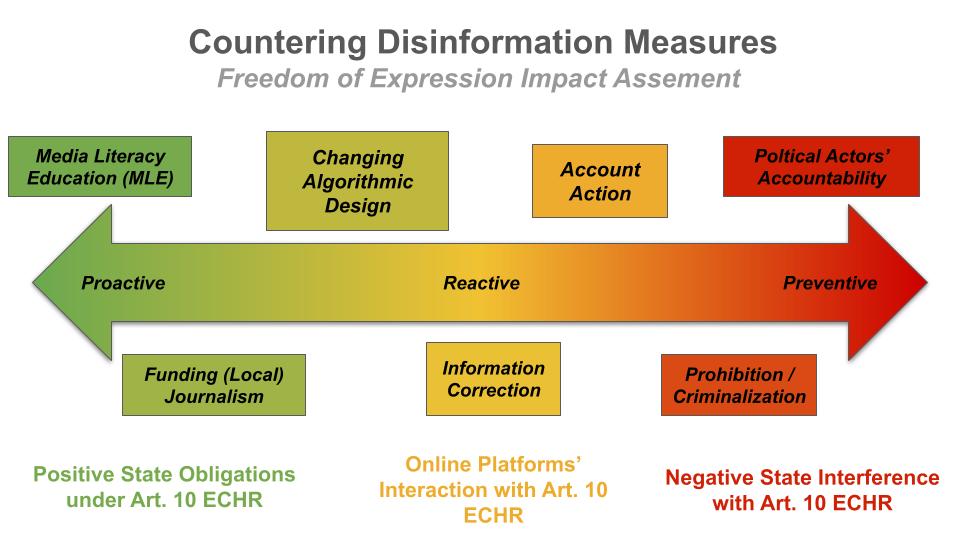
A first category consists of what might be termed “proactive measures”, such as media literacy initiativesand supporting (local) journalism. These measures do not target disinformation directly, but aim to strengthen the information environment by educating citizens and ensuring access to high-quality journalism. Free speech scholars generally favour such approaches, as they have virtually no negative impact on expression. Their drawbacks, however, are also well known: they are slow to implement, difficult to scale, and costly. Media literate generations are not raised overnight; journalism’s economic decline will not be reversed by the next fiscal quarter. While States and the EU increasingly invest in these long-term strategies, it is understandable that regulators also feel compelled to address disinformation campaigns unfolding right now.
This leads to a second category of “reactive measures”, where co-operation with online platforms is central. Bradshaw recognized that the issue of disinformation is amplified by social media. To combat disinformation, regulate social media: so the solution goes. A first proposal focuses on changing algorithmic design, including proposals to promote authoritative content and demote disinformation (see Measure 18.1 of the Code on Disinformation and Article 18 of the European Media Freedom Act). Yet empirical research suggests that much disinformation consumption is driven by users actively seeking it out, limiting the effectiveness of purely algorithmic interventions.
Thus, another reactive strategy involves information correction through labelling or fact-checking (Commitments 30–33 of the Code). In Bradshaw, the Court recalled that mandatory “foreign agent” labelling has been found incompatible with Article 10 ECHR. This goes against current corporate practices, where it is common for platforms to label Chinese- or Russian state-affiliated media in order to signal limited editorial independence (p. 35–41). When fact-checking and labelling have proven insufficient, Meta has resorted to more intrusive measures: banning Russian state media from their platforms.
This brings us to a next category of platform measures: user account action through content removal, demonetisation, or account suspension. In the case of inauthentic networks – what Bradshaw refers to as “troll farms” or “cyber troops” – deplatforming raises fewer concerns, as the speech does not come from “genuine” users. Matters become more complex when “real” individuals are involved. Undisclosed or poorly justified moderation decisions against user content raise serious freedom of expression concerns. This is precisely why the Digital Services Act provides users with an extensive catalogue of procedural safeguards against content moderation decisions, including a statement of reasons (Article 17 DSA) and internal and external appeal mechanisms (Article 20-21 DSA).
Reactive measures nevertheless suffer from two structural shortcomings. First, they depend on sustained cooperation with online platforms, which has become increasingly fragile with Big Tech appearing less and less acceptive of regulatory oversight. Second, content moderation is inherently reactive: it responds to disinformation after it has begun circulating. This has prompted calls for a more preventive approach aimed at discouraging the creation of disinformation in the first place.
“Preventive measures”bring us into the “red zone” of free speech regulation. The prohibition of disinformation risks producing chilling effects and is therefore viewed sceptically by many free speech scholars. Bradshaw leaves the proportionality of such criminalisation under Article 10 ECHR unresolved. On the one hand, the Court cites the High Commissioner for Human Rights’ recommendation to avoid criminalising disinformation (para 64 j. 160). On the other hand, it notes the UK’s creation of various novel disinformation-related offences (para 169) without subjecting them to Article 10 ECHR scrutiny, thereby implicitly validating them as proportionate Article 3 P-1 interventions. This ambiguity echoes Avagyan v. Russia, where the Court found no issue with the legality of the offence of “wilfully disseminating untrue information”, but faulted its incorrect application by domestic courts. As more and more European States move toward prohibitive sanctions, clearer guidance from Strasbourg on the compatibility of such offences with Article 10 is to be expected.
Finally, there is the issue of what to do when the call is coming from inside the house. Bradshaw could not resolve the delicate question of what happens when disinformation originates not from foreign actors, but from domestic political actors or governments themselves. In a populist political climate, balancing the electorate’s right to be well informed against politicians’ reliance on exaggeration, hyperbole, or strategic omissions may very well be the Court’s next frontier.
These regulatory responses form a continuum, shown in the pictogram below:
So where does all this leave us with Bradshaw? Strasbourg’s mandate is clear: weaponizing disinformation is real, electoral processes are in crisis, and States must do something. Yet the problem is vast, complex, and immune to silver-bullet solutions. So, it is up to States to figure out which “something” works best. Many measures designed to safeguard Article 3 of Protocol No. 1 will inevitably interfere with Article 10 ECHR. The Court’s message to Contracting Parties is therefore pragmatic instead of dogmatic: experiment away, we will intervene when the balance tips too far. In the meantime, it falls to scholars, regulators, and domestic courts to identify the hard limits of this experimental space, rather than leaving this Sisyphean task to forty-six ECtHR judges alone.

Strasbourg Observers is an academic blog that discusses recent developments at the European Court of Human Rights. The blog is run as an inter-university collaboration amongst the Dutch-language universities of Belgium. Associated research groups are the Human Rights Centre at Ghent University, the Centre for Government and Law at Hasselt University, the Leuven Centre for Public Law at KU Leuven, the Law and Development Research Group at the University of Antwerp and the Vakgroep Publiekrecht at the Vrije Universiteit Brussel.
Strasbourg Observers would not be possible without the valued work of countless guest bloggers. Visit the “Contact” page on our website to find out how to become one!